2 Inbound Engagement Plays That You Should Start Today
5/28/2022
Comments
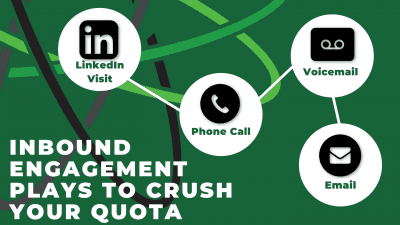 Need to crush your Q2 quota? Check out this tried and true method for inbound engagement. It's all about layers of contact to make a big impact.
Phase One The Task: Visit the person's LinkedIn profile The Why: Every time you visit someone's page your name will show up on the prospects page under Analytics. Phase Two The Task: Call them for the first time at 10-15 minutes before the top of the hour. The Why: Most people have meetings that start at the top of the hour. This increases your chance of getting them on the phone. The Script: If they answer, your script could look like this: “Good morning {{first name}}, how are you doing? This is _____from _____. We received your inquiry for_____ on _____, and I am reaching out to learn how I can help.” Phase Three The Task: Suppose they don't answer, hang up and try back 10 minutes later or leave a voicemail. The Script: VM script could look like: Hello Pete, This is David from xyz. I am responding to your inquiry for more information. Tim, I will send you an email, but if you prefer to reach out via phone my number is 555-555-555. Again, this is David, from xyz, and my number is 555-555-555. Looking forward to hearing from you Pete! Phase Four The Task: Email Them - Send them an email following up on your VM. Hello Pete, Just left you a voicemail in response to your request. Let me know how I can help. You can hit reply or call me back at 555-555-555. I look forward to hearing from you Pete. If it's easier, feel free to book time on my Chili Piper link here P.S- How about those Blue Jay's 10-6 start (If you see that your prospect is a die-hard fan, try and build rapport with them early on. Your engagement rates will skyrocket ). Not sure if you're familiar with gambling, but I was in Vegas last week and bet $100 to win $900. It's a lock, right? (VEGAS ODDS +900) Email Must-Have: Make sure your signature includes your company name, phone number, LinkedIn, Instagram, links. Your prospects will be able to learn more about your company even if they don't respond. Sometimes the win is the prospect opening up your email. So don't be discouraged if you don't get a response right away! Key Takeaways Open the call immediately by addressing, "Why are you calling/emailing me?" Let them know you sent a voicemail, signaling that you are persistent. {{Call-to-action}} in the close - "Looking forward" - tells Pete he needs to take action. The P.S is used to build rapport with your prospect. #BlueJay'sExample Email signature tells Pete "who is calling" - If they are busy executives, it's crucial that you give them an option to book on your Chili Piper or calendar link that your company is using.  Tenbound, the leading Sales Development Research & Advisory firm, today announced their virtual and in-person Sales Development conference series schedule for 2022.
The goal for these virtual & live conferences is to empower all participants to take control of their ability to produce Sales Development success in 2022 and beyond. Through the knowledge acquired from top Sales Development speakers at each event, attendees go forward with the tools and confidence to meet and exceed their professional goals. Furthermore, conference attendees can partner with our sponsors, providing them visibility and creative interaction with a targeted audience of decision-makers and influencers who are in the process of evaluating Sales Development products and services. Tenbound’s conferences will provide sponsors with virtual breakout rooms for the virtual events and a conference expo area for its live event (subject to any applicable public health order) that will enable sponsors the opportunity to interact with attendees in a collaborative and synergistic environment with qualified Go-to-Market professionals. “The Sales Development Pipeline industry continues to expand, fulfilling a critical need in B2B Saas Companies and beyond: a predictable sales and talent pipeline. The people, processes and technology stack to support the SDR function continues to mature, and the Tenbound Sales Development Conference series brings together the top minds in the industry to focus on strategy, tactics and technology to help our community achieve its goals”, said David Dulany, Tenbound Founder & CEO. “By continuing to gather the top minds in Sales Development and focusing on the strategies and tactics that are working now, while also looking to the future, we aim to push the practice of Sales Development forward and help guide leaders through this challenging time. Tenbound created the 2022 Conference Series to help Sales Development leaders reach their goals through high-quality content and actionable presentations in both virtual and in-person settings.” Tenbound’s 2022 Conference Calendar:
For more information about the Tenbound conferences for attendees or for sponsorship, please visit https://tenbound.com/conference/ About Tenbound Tenbound helps B2B SaaS companies build multi-billion-dollar Sales and Talent pipelines through Value-as-a-Service. We help identify our clients’ top sales and talent pipeline growth priorities and partner to achieve those priorities through our innovative research, advisory, and events. As the only firm focused on sales pipeline achievement, we bring a unique perspective to the market. For more information, including a free Sales Development consultation from our expert team, visit our website to learn more: https://tenbound.com/ 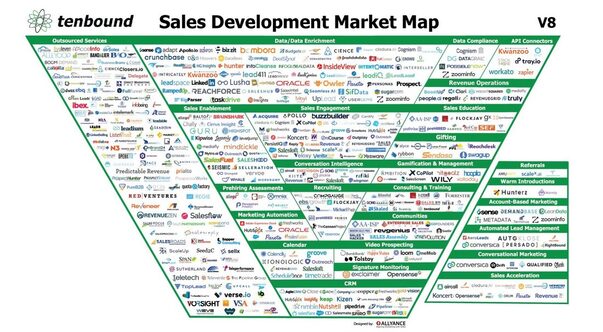 Video Prospecting - now generally accepted in the SDR tool stack
We have seen the development of prospecting beyond phone and email to include physical mailings and now, video prospecting is becoming ubiquitous. In the era of Zoom meetings, prospects have become accustomed to video so it’s no surprise that SDRs are finding success using it in their outreach sequences. More providers are entering the space, and the delivery of the videos and metrics sounding its effectiveness continues to improve. Look for a move to the metaverse as prospects become more accustomed to that channel. Revenue Operations - gaining momentum as the ultimate dashboard for SDR team success Combining the disciplines of Sales Operations and Marketing Operations into a cohesive Revenue unit has become a common practice to support Sales Development teams, and managing applications to drive Sales Development success continues to rise in sophistication. Key players are emerging with heavy venture capital investment. Look out for more consolidation in this space and greater sophistication and adaption as Sales Development matures as a practice. Sales Enablement - Bridging The Work-from-home gap in SDR sales skills With Sales Development Reps working at home, the usual office learning, tribal knowledge, and banter are now missing to support their development. Companies are struggling to find new ways to keep SDRs engaged, trained and motivated. As a result, we’re seeing the Sales Enablement category continue to evolve in new and more advanced ways to meet that need. Look for growth in this area as companies move to use AI and machine learning to understand how voice tone, timing, word choice, and other factors affect pipeline production. Once Again - Zoominfo (ZI) Eating the World Zoominfo continues to lead on many fronts and is essentially becoming the overall Sales Development Operating System. Its strategy is clear; to become a one-stop-shop for your Pipeline and Sales needs, from Data to Enrichment, to Targeting, to Execution, and beyond. They call it the Total Platform, and according to ZI it “Aligns Your Marketing and Sales Tech tack into a unified platform” including Contact Data, Company Data, Technographics, Intent, Conversation INtallentce, Sales Intelligence, Prioritized Targeting, Conversational Marketing, Enrichment, and Audience solutions (AMB). At an (as of today) $23B Market cap and legendary Henry Schuck at the helm, we expect continued success and an overall trend of market consolidation in the SDR tech space. Email Deliverability - The next Market Map quadrant? SDRs are spending a lot of time personalizing emails to fit their prospect’s pain points hitting send, and hoping for the best. Alas, the email goes straight to spam or some other purgatory where it never even reaches the inbox of the prospect. How much time is wasted? In response, a whole new crop of tools is being developed to ensure this specific problem is solved. On the flip side, we’ve seen one tool which requires you to donate to charity in order to get your email delivered. Revenge of the Prospects! Ready to learn more? Attend the upcoming Tenbound Virtual Sales Development Conference to meet the key people and tech providers in our industry. Register here. All the major players in Sales Development are represented at Tenbound Conferences and can be available to demo. What did we miss? What would make the Map and Directory more useful? Leave a comment! 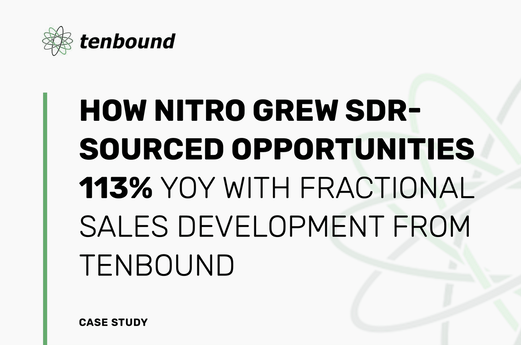 Download the full Case Study here!
Nitro was growing fast. Their business productivity software was being used by over 13,000 companies worldwide, and it was time to adjust their SDR playbook to keep up. Up to this point, Nitro’s SDRs had focused exclusively on inbound leads; that would have to change in order to scale at the pace that Nitro was at. In a perfect world, the SDRs would have a leader in place to help adapt. That deft hand would help train the team and add to their playbook. Of course, things rarely ever happen perfectly. As it turned out, right when Nitro was at this inflection point, their Global SDR Director resigned. With no qualified prospects on the market to replace him, VP of Growth & Enablement Nellie Aube took over the SDR team. She was passionate about developing sales talent, but already had her hands full juggling multiple roles. “While we were looking for a Global SDR Director, we were also growing our enablement team and preparing a new manager to take over that group. In the interim, I was running both teams, leading the upsegment development plans, and building our cross-functional strategy with marketing,” she explains. Although Nellie had an impressive handle on the big-picture for the growing teams, there just weren’t enough hours in the day for her to deliver direct training to the SDRs: “Our SDR reps needed individual attention to develop outbound selling skills. But with me having essentially three different jobs, there was no way I could coach them all one-on-one.” The team needed support, and there were no qualified candidates to fill the SDR Director role on the horizon. Things were still growing at a rapid place, and Nellie needed three things as soon as possible:
If you’re curious about Pete’s strategy, you can read the full case study here. If you want to know how that strategy worked, well, the results speak for themselves. In six short months, Nitro’s SDR team mastered telephone outreach and delivered an astonishing 113% YOY increase in opportunities for the sales team. Their efforts helped grow the total outbound pipeline by 70%, and drove a 20% increase in SDR-sourced revenue in H2. It might be months before Nitro finds a new Global SDR Leader, but – thanks to Pete’s work – Nellie isn’t worried about the wait. Her partnership with Tenbound is meeting her company’s needs and it continues to elevate performance and morale among the SDRs. “Without Tenbound, I’d be getting no sleep. I would have dropped high-priority items while we struggled to find a new SDR Director. We wouldn’t have this level of trust and engagement on the SDR team, and we wouldn’t have a thriving outbound pipeline.” Download the full case study here.  It’s hard to stay focused these days. Especially working from home. It takes a lot of discipline.
There’s so much information out there on the various social networks and so much uncertainty in daily life, it’s very easy to become confused and disoriented. If you lose your focus and start scrolling, millions of online gurus will soon be giving you advice (much of it very good advice, some not-so-good) - advice that you could implement into your life, and your business, to get it back on track or take it to the next level. The amount of advice and information available today is truly unprecedented. It’s coming at you like an information firehose. That’s all good, but there are two sides to the coin. It’s easy to fall into the trap of "information overload". At this point, adding more information into our already flooded brains just causes more confusion. That in turn causes you to go back online looking for more information, which in turn gives you more information and contributes to more information overload and confusion. At some point, you need to stop scrolling, close the social networks, look at the actual operating system for your life that you have in place, and see if it's any good. By operating system, I mean the process you’re following day-in and day-out of positive habits, mindsets, and actions that will eventually lead to achieving your goals. And if you have an operating system, are you following it a little bit each day, and is it taking you in the right direction that you're trying to go with your life? Is your system building your business, improving your prospecting, your health, your life, your relationships... or are you just drifting, seeking more advice. Have you established an operating system to integrate all that great advice into your life? If not sketch it out today, and start following it. Promise yourself not to add any more advice or information to the system until you at least have some sort of system that you're repeatedly doing. I’ve used a version of Darren Hardy’s Best Year Ever system for many years and it works great. There are a lot of them, try one and see what works for you. Watch out for the information overload loop, or spiral. After you get good information, get a good system and stick to it. Need help? Contact Tenbound for a free coaching session with a Tenbound Certified Coach.  This could be the most important news you read in Sales Development this year:
A full 46% of Americans report getting spam calls every single day. There were just under 46 billion robocalls made to American numbers in 2020. It’s a problem in search of a solution, and the FCC has taken a number of steps recently to bring an end to telephone scams, spam, and abuse. Effective from June 2021, all service providers are required to use the STIR/SHAKEN framework to authenticate callers and reduce if not eliminate robocalls and phone number spoofing. That’s good. But an unintended consequence of this is the number of legitimate businesses getting caught in the cross-fire. And that’s bad. What is STIR/SHAKEN? STIR/SHAKEN — which stands for the Secure Telephone Identity Revisited (STIR) and Signature-based Handling of Asserted Information Using toKENs (SHAKEN) — is a framework of standards and protocols to be used across various networks. With it, originating service providers will confirm a number and user as legitimate, while other carriers will further verify that information before it reaches the intended recipient. In theory, it would identify the caller as either ‘unknown’ or ‘spam’ if they’re using robocall or spoofing services because they would fail this authentication process. Number comes up as spam, do not answer. Simple, but effective. Unfortunately, even the best laid plans often go awry, and STIR/SHAKEN is wreaking havoc among SDRs and other individuals who rely on cold calling for proper business purposes. The Impact of STIR/SHAKEN At the best of times, a connect rate in the vicinity of 7-10% is average for cold dials. In the months since STIR/SHAKEN was implemented, some businesses have seen that number plummet to only 1-2%. The difference? Those legitimate users are coming up as spam for a variety of reasons, including (but not limited to): The number is not registered to your business The number was recycled and previously labeled as spam The user is running afoul of spam algorithms The only way to know for sure is to check it yourself. Call your own mobile phone and see what comes up. Or better yet, call a few friends or family members and ask them. If your business number(s) is repeatedly failing its authentication, it’s no wonder your connect rate has fallen through the floor. No one is ever going to knowingly answer a call labeled as spam. So, what do you do? Playing Nice with STIR/SHAKEN First, do an audit of all numbers used for business purposes. Are they coming up as ‘verified’ or ‘spam’? Next, contact your (cadence, sequencing, or dialing) service provider and confirm that the number(s) are registered to you and your business. The ease and convenience of this will vary depending on your specific provider (standalone dialing tools will be best). Unfortunately, many numbers are recycled. If a previous user was identified as a spammer, the number itself is likely unsalvageable. Get rid of it, and buy a new one. And don’t forget to immediately register it. Finally, be aware of the red flags that spam algorithms look for, such as: Calling the same outbound number several times in one day Using the number too frequently An actual spam complaint Audit your business numbers at least monthly, eliminate those labeled as spam, and play by the rules for legitimate and verified use. Protect your verified and clean numbers. Business cold calls are not spam when you’ve done your homework and know your prospects. Don’t let something designed to prevent scammers keep you from solving their needs. Need help? Tenbound is a Sales Development Research and Advisory firm providing expert guidance and integrated technology solutions to help you take your Sales Pipeline to the next level. Contact us today to get started.  Prospecting has changed significantly in the past few years, and methods must be updated to meet today’s new demands and challenges.
No industry has been immune to the changes and disruptions of the past couple of years. As businesses around the world continue to adapt to the new sales and marketing landscape, the need to keep up with constantly evolving customer demands is greater than ever. But with any challenge comes new opportunities, and Sales Development is no exception. Since the beginning of the pandemic, many of your customers have new needs and work remotely. They have different priorities and pain points that must be addressed if you are to continue to earn their attention or to acquire new customers. Having a strategy for whom you intend to prospect will prove vital to your success. After all, successful prospecting requires, just as it always has, comprehensive knowledge of your target customer. Dogma does not equal performance In today’s technology-driven world, change is inevitable and necessary for keeping up with the constantly changing sales landscape. This is why one of the most harmful phrases in the business world is ‘we’ve always done it this way’. Dogma does not equate to performance, which is why every process must be taken back to formula. In the case of Sales Development, this means starting with the right questions. Firstly, how do you yourself buy today? Putting yourself in the shoes of today’s customers is an essential first step towards better understanding their needs and pain points. Then, looking at what your current data is telling you, determine how your customers buy. Finally, look at how your existing Sales Development processes work. Chances are there are misalignments between these variables, which will need to be addressed in order to refine your prospecting strategy. Applying the scientific method to Sales Development Sales Development is effectively just a form of project management which, in turn, follows the scientific method. The basic steps of the cycle are as follows:
Sales Development Reps (SDRs) should also apply the scientific method. In a modern context, that means referring to existing data to determine how sales are currently performing. You can then identify opportunities for improvement, make the necessary changes, and then test them. With A/B testing, you can also put multiple hypotheses to the test simultaneously, thus saving time and developing your sales processes even faster. The entire cycle is one of continuous improvement. At Tenbound, we recommend reevaluating your Sales Development processes approximately every three months. Key takeaways for SDRs Sales Development success depends on determining how your existing processes align with today’s buying experience. Wherever there is a misalignment, you need to go back to recreate or refine your strategy to achieve better results. This requires the optimal combination of expert guidance, a strong peer support community, and a consistent strategy that matches the unique requirements of your business. Check out my talk at the recent Tenbound Sales Development Conference where I go into this further https://youtu.be/pGY0HFIO_xY?t=55 Tenbound is a Sales Development research and advisory firm. We provide expert guidance and integrated technology solutions to help you take your business to the next level. Contact us today to get started.  Discover Your Sales Development (SDR) Program Score with this free program scorecard.
For emerging and current leaders of Sales Development and Go-To-Market teams. Increase your ability to drive a reliable SDR Sales Pipeline. Click here to start the survey. This scorecard has been designed to show Go-To-Market Leaders their blind spots and provide instantly actionable steps to boost Sales Development results. It takes just 2 minutes It’s completely free Receive customized results instantly Based on the new book 'The Sales Development Framework' and developed over the last 4 years interviewing over 500 Sales Development Leaders in Silicon Valley and beyond, the Scorecard has become a trusted tool for shaping your competitive edge in the Sales Development industry. Click here to start the survey. |
Blog Archives
November 2023
September 2023
December 2022
November 2022
October 2022
September 2022
August 2022
July 2022
June 2022
May 2022
February 2022
January 2022
December 2021
November 2021
October 2021
September 2021
July 2021
June 2021
May 2021
February 2021
January 2021
October 2020
September 2020
June 2020
May 2020
April 2020
March 2020
January 2020
December 2019
November 2019
September 2019
August 2019
June 2019
May 2019
March 2019
February 2019
November 2018
October 2018
July 2018
April 2018
March 2018
February 2018
November 2017
October 2017
September 2017
June 2017
May 2017
April 2017
March 2017
February 2017
January 2017
September 2016
August 2016
May 2016
September 2015
March 2015
February 2015
January 2015
Categories
All
Book
Boost Sales
Career
Coaching
Cold Calling
Communities
Conference
COVID-19
Infographic
Job
Leaders
Leads
Management
Market
Outsourcing
Pandemic
Podcast
Psychographics
Sales Development
SDR
Seminar
Social Media
Team
Technology
Trade Shows
Training
Trends
Weekly Newsletter
Get the Best Boss Ever:
|
